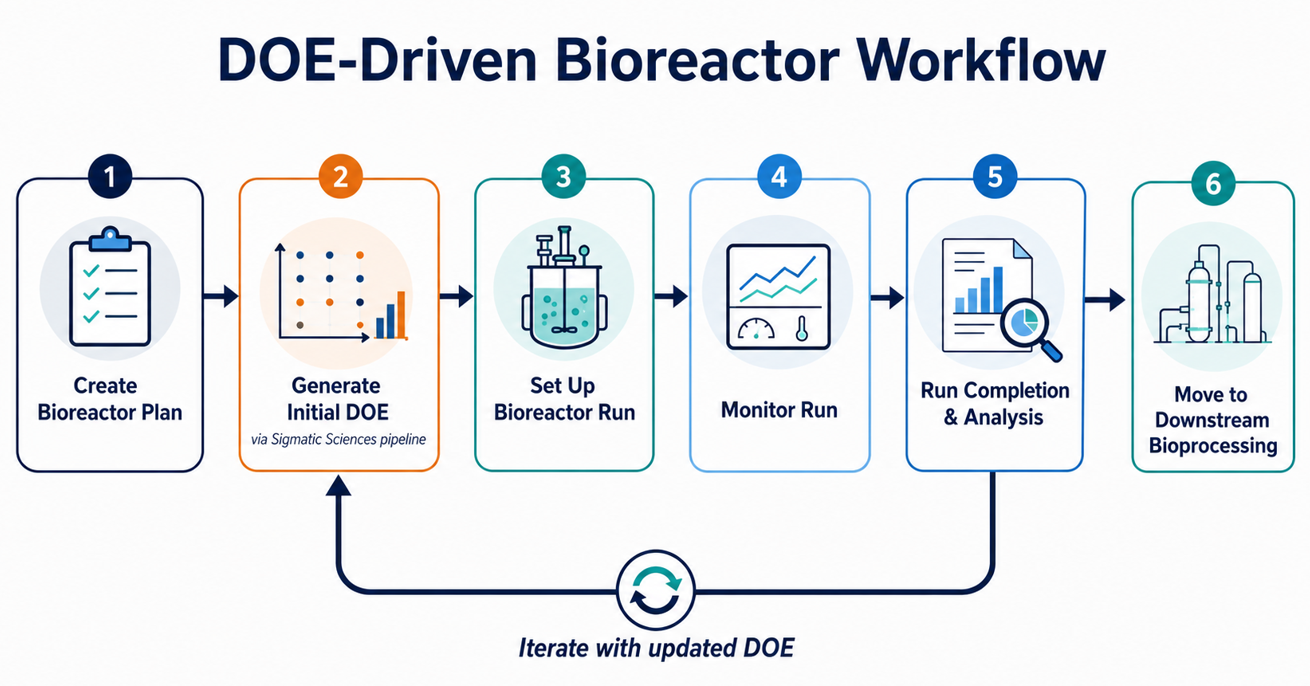
A multi-agent pipeline that plans, executes, analyzes, and iterates your bioreactor campaigns — turning DOE from a spreadsheet chore into a living optimization loop.
Watch the Engine Think ↓ See a Demo for Yourself
Designing experiments in one app, running them on bioreactors, logging data in a LIMS, and re-keying results into a statistics package — that loop costs weeks per iteration and leaves your best scientists doing copy-paste instead of science.
Six agents, one loop. The Plan agent defines the experiment space; the DOE Designer generates it; Execution runs the vessels; Data ingests every metric; the Optimizer proposes the next round; and the Decision Gate either iterates or hands off to downstream.
The dashboards your team actually works in — from plan definition to the final DOE report.
No export/import. Factors and responses defined in the plan go straight to the Sigmatic pipeline; setpoints come straight back into the run.
Specialized agents for planning, design, execution, data, optimization, and the go/no-go decision — each with a traceable record of what it did and why.
Real-time visibility into the pipeline as it executes — plus a report with predicted optima, response surfaces, and method notes you can interrogate.
Optimize media composition (glucose, glutamine, cysteine) and process setpoints (T, pH, agitation) in a single experimental design — capturing interactions OFAT can't see.
Model order adapts — main-effects while data is scarce, full quadratic once runs accumulate. Every iteration gets smarter with your actual data.
Maintenance schedules, technician attribution, per-vessel sample tracking, and automatic data pull from connected analyzers. Role-based views throughout.
A representative mid-size upstream process development team, moving from manual OFAT-style iteration to DOE-driven closed-loop development.
| Impact Area | Before | With Integrated DOE | Annual Value |
|---|---|---|---|
| Optimization cycle time | 4–6 weeks / iteration (manual analysis + re-design) | 1–2 weeks / iteration (auto design + report) | $250K–$600K in earlier process lock |
| Experiment efficiency | OFAT: misses interactions, needs more rounds | DOE/BO: captures interactions in 12 runs | $100K–$300K in reagents + bioreactor time |
| Titer / yield uplift | Baseline | +10–25% from optimized window | $1M–$5M+ at production scale |
| Data handling & audit | Spreadsheets, re-keying, manual audit trails | Automated capture, traceable, instrument-linked | $50K–$150K analyst time + reduced QC risk |
Conservative figures for a team running ~4 development campaigns/year on a 12-vessel microscale platform. The dominant value is time-to-optimized-process — the earlier you lock a high-titer window, the cheaper every production batch becomes.
Lead scientists and engineers running upstream optimization campaigns on microscale and pilot scale.
Teams translating development results to production and defending the process window.
Coordinators managing instruments, vessel scheduling, sampling, and data integrity.
Contract organizations juggling multi-client campaigns that need fast, defensible optimization.
Book a live demo tailored to your campaign — we'll configure the factors, responses, and platform that match your work and walk you through the full loop, from plan to downstream handoff.
See a Demo for Yourself