From screening through titer, Sapio manages the full ADA and NAB workflow in one compliant platform — with statistical cut point calculation, enforced cascade order, and a complete decision history your regulators can follow.
Follow the Cascade ↓ See a Demo for Yourself
Understanding the relationship between drug exposure and immune response is critical — but only possible when both datasets are visible together. Low exposure can drive immunogenicity, and immunogenicity can drive lower exposure. Without a connected view, it's easy to miss what's actually happening.
Having PK bioanalysis and immunogenicity workflows in one platform means your teams can see both sides of that relationship clearly — leading to faster, more confident decisions across the program.
When ADA classification relies on manual cut point calculations, disconnected tools, and process discipline alone, the risk isn't just inefficiency — it's a defensibility problem when regulators ask questions.
Cut point calculations are usually done in spreadsheets and outlier detection is difficult. Being able to recreate what happened for a sponsor or regulator takes effort and time.
Systems or processes don't actually reflect the science that needs to be done, adding burden to the analyst and creating potential gaps in SOP adherence.
ADA classification decisions — which samples were flagged, which were confirmed, which were excluded — are often spread across notebooks, emails, and spreadsheets. Inspection readiness means piecing it all together.
Your assays managed in sequence and in one system. The platform takes care of the workflow so you don't have to.
Every sample is read against a statistically calculated cut point. Positives advance — negatives stop here.
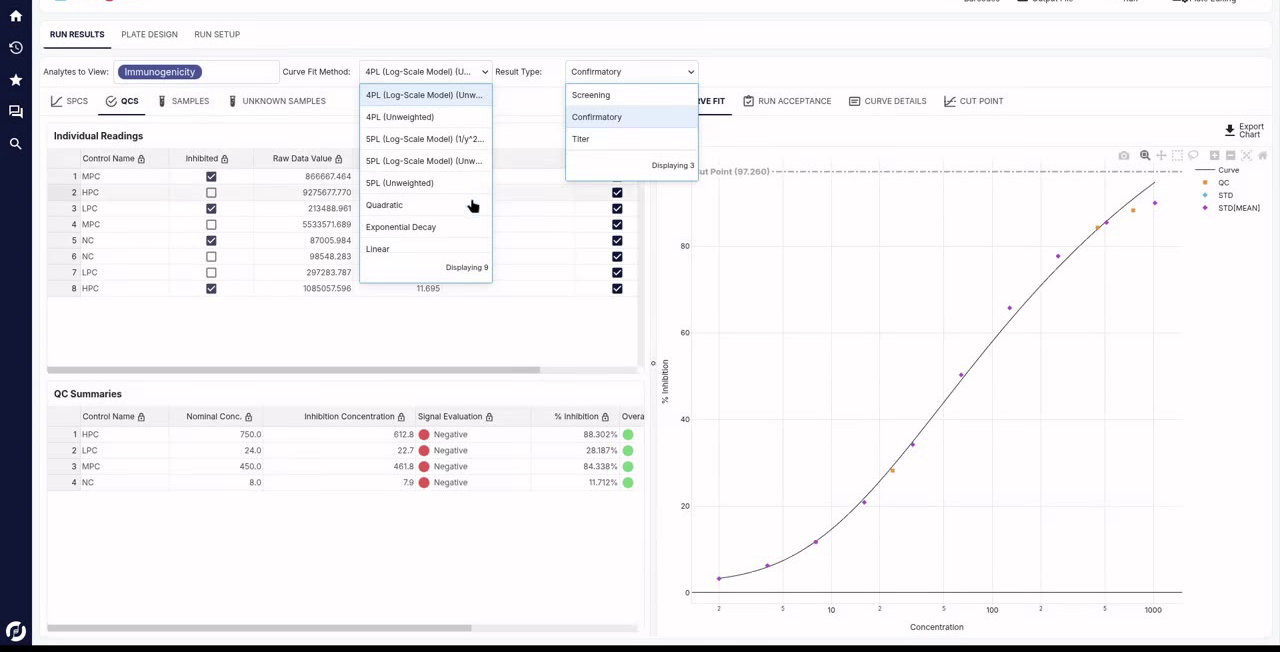
screening cut pointScreening positives are re-tested using inhibition to confirm true positivity and rule out non-specific binding.
% inhibition thresholdConfirmed positive samples are serially diluted to quantify antibody levels. Titer calls are recorded with a full audit trail.
titer auto-calledNeutralizing activity is assessed — a final positive or negative read with its own validated cut point.
neutralization assayCut points are calculated by the platform — not a spreadsheet. Outlier removal, normality testing, and method selection are documented automatically, giving you a defensible number with a complete decision history.
Every cut point carries its own record — which runs were included, which samples were excluded, and why. When a regulator asks how you got the number, the answer is already there.
Inhibited and regular samples share the same instrument run. Screening and confirmatory data come out together — no separate plate, no separate transfer.
Selectivity and interference checks — across normal, hemolyzed, and lipemic matrices — are built into the validation structure, not managed separately.
Confirmed samples are diluted and titered with results recorded automatically. Scientists can override with an e-signature and reason — every decision is on the audit trail.
Required validation runs — cut point, sensitivity, selectivity, drug response — must be complete and accepted before an assay can be approved for use. No shortcuts, no gaps.
A representative program running ADA and NAB across clinical cohorts, replacing manual cut point spreadsheets and disconnected tools with a single compliant system.
| Impact Area | Today | With Integrated Immunogenicity | Impact |
|---|---|---|---|
| Cut point defensibility | Spreadsheet calculation, exclusions by memory | Platform-calculated with full decision history | $100K–$500K in avoided findings and re-evaluation |
| Misclassification risk | Tier progression managed manually | Enforced cascade — samples cannot advance out of order | $50K–$250K in avoided retests and safety exposure |
| Assay validation time | Manual plate setup, curve fitting, QC checks | Templates, structured validation, and acceptance tracking | $80K–$200K analyst time per assay program |
| Study turnaround | Weeks between tiers, manual titer reads | Faster tier progression, titer calls on record | $50K–$300K in earlier ADA decisions for the program |
Conservative figures for one clinical program with ADA and NAB monitoring across ~1–2 cohorts per year.
Lab heads and analysts running ADA and NAB programs who need a structured, compliant workflow — not a collection of spreadsheets.
Teams who own the cut point methodology and want it applied consistently, with every calculation and exclusion decision on record.
Pharmacovigilance and safety teams who need clear, consistent ADA readouts they can act on — without waiting for manual reconstruction.
Quality teams and contract labs who need repeatable, audit-ready workflows across multiple programs and clients.
Book a live demo tailored to your program — we'll walk the full cascade from screening through titer using your assay type and validation requirements.
See a Demo for Yourself