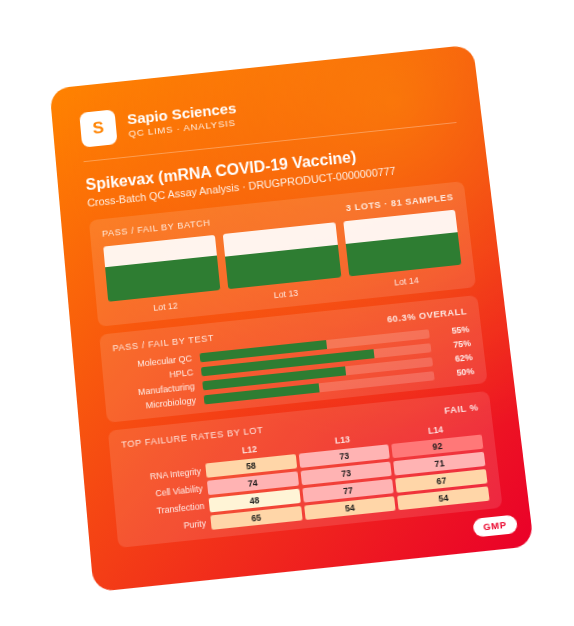
Compose assay processes from reusable templates, set the limits and reporting rules, dual e-sign, and publish to frozen, versioned processes. No developer ticket between your lab and a compliant new workflow.
Watch a Method Go Live ↓ See a Demo for Yourself
Your QC lab changes constantly — a new product, a revised limit, a corrected pick list, a new assay. When configuration sits behind a developer ticket and change control, each one costs weeks, the lab waits, and the change history fragments across ticketing tools and email. Your best people end up doing data entry instead of science.
Six stages, one afternoon. Pick the process type, compose unit operations by dragging published assay templates, set the specs and warning ranges, attach the reporting rules, get two e-signatures from different approvers — and publish an immutable version your QA team can defend to any inspector.
ELaiN, the AI co-scientist built into the platform, turns a one-sentence prompt into a finished analysis — drug-product pass/fail heatmaps, per-batch statistics, and lab KPI dashboards. Ask it to run one every Friday and email it to you, and it will. It works with the major AI assistants, and every request is access-controlled and logged like any other action in the system.
Build an assay process by dragging published experiment templates into unit operations. Order is preserved — workflow within unit operation, unit operation within process.
An HPLC, visual inspection, or microbiology assay configured once is a reusable asset — across QC LIMS, Stability, and CMC processes, products, and sites.
Every field is auto-discovered from the included templates. Flag criticals, decide what gets reported, set min/max acceptance, and constrain answers with pick lists.
Separate acceptance from warning limits (e.g., acceptance 280–320, warn 270–330). Drift is flagged the moment data is entered — before it becomes an investigation.
Control how numbers appear on reports: NMT reporting limits, value-dependent decimal precision, rounding modes. Consistent, defensible results, every time.
Publish with e-signature, dual approval from different people, and version freeze. Published versions are view-only; changes produce the next version. Full audit history.
A representative QC lab moving from ticketed, developer-mediated configuration to self-service with GMP dual control.
| Impact Area | Today | With Self-Service Configuration | Annual Value |
|---|---|---|---|
| Assay / method change lead time | 2–6 weeks (IT ticket + build + rework) | Same day — scientists configure, dual e-sign | $50K–$200K in delayed release testing |
| OOS / investigation load | Manual limits, drift caught at review | Warning ranges + critical flags at the spec | $30K–$150K in avoided false OOS investigations |
| New product / assay onboarding | Rebuild the process each time | Compose from reusable templates | $20K–$100K in setup cost & time |
| Audit & inspection readiness | Change history in tickets and email | Immutable versions + e-sign trail | $50K–$250K in risk & finding cost |
Conservative figures for a lab with ~10 method/assay changes a year and 2–4 false OOS events. The dominant value is the queue you remove — every change your scientists can make themselves, in hours, with the signature control QA already requires.
Analytics and QC heads who own assay configuration and are tired of queuing behind IT for a revised limit.
Change control, e-signature, version history, and inspection readiness — defensible without a single spreadsheet.
Managers chasing throughput: fewer queues, less rework, and data that is constrained at the point of entry.
Contract and multi-site organizations that need the same compliant process replicated across clients and facilities.
Book a live demo tailored to your lab — we'll compose one of your own assays: templates, specs, limits, warning ranges, and approval groups — and walk the full path from draft to frozen version.
See a Demo for Yourself